

Who is Legally Required to Have a TM44 Inspection?
The TM44 Legal Requirement: Who Is Obliged to Have an Inspection?
The TM44 legal requirement applies to any building where air conditioning systems have a combined effective rated output above 12kW — and it falls on whoever controls the operation of that system, whether that is the building owner, landlord, or tenant.
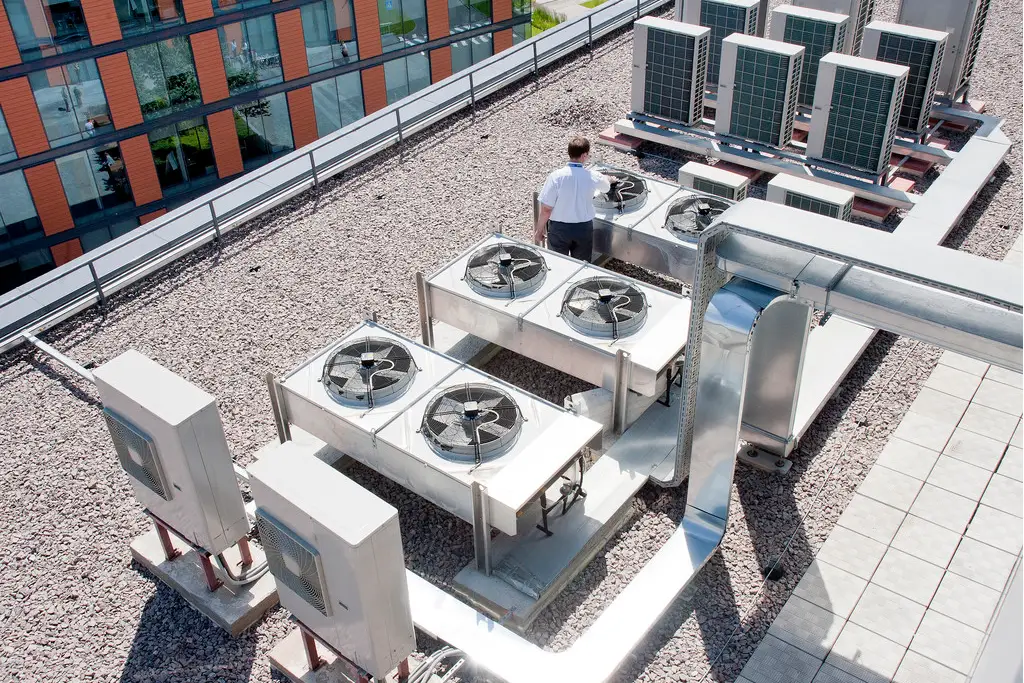
The obligation is mandatory under the Energy Performance of Buildings Regulations, yet many building owners and facilities managers across the North East remain unaware of it — or assume it does not apply to them. This guide explains exactly who the TM44 legal requirement covers, when it applies, and what happens if you fail to comply.
At AirCert, we carry out TM44 inspections across the North East of England and Yorkshire from our base in Middlesbrough. We hold Elmhurst Level 3 and Level 4 accreditation, meaning we are fully qualified to inspect and certify air conditioning systems of all sizes and complexities. In this guide, we draw on our professional experience to clarify who the TM44 legal requirement applies to and help you understand whether your building needs a certificate.
Understanding the TM44 Legal Requirement
What Is a TM44 Inspection?
A TM44 inspection is a legally mandated assessment of air conditioning systems in commercial and public buildings. The name comes from CIBSE Technical Memorandum 44, which sets out the methodology for conducting these inspections. The purpose is to evaluate the energy efficiency of your air conditioning system, identify areas where energy is being wasted, and provide practical recommendations for improvement.
The TM44 legal requirement originates from the Energy Performance of Buildings (England and Wales) Regulations 2012, which transposed the EU Energy Performance of Buildings Directive into UK law. Despite Brexit, these regulations remain fully in force and enforceable across England and Wales.
The Key Threshold: Combined Effective Rated Output
The TM44 legal requirement applies to any building with an air conditioning system that has a combined effective rated output of more than 12 kilowatts (kW). This is the single most important figure to understand. If your system meets or exceeds this capacity, you are legally required to hold a valid TM44 inspection report.
Crucially, the 12kW threshold refers to the combined output of all units — not each individual unit in isolation. Many building managers assume that because each unit is relatively small, they fall below the threshold. In practice, a building with several smaller split systems — common in offices, retail units and serviced accommodation across Teesside and the wider North East — can easily exceed 12kW when the outputs are added together. This is where the TM44 legal requirement catches many businesses off guard.
How Often Must Inspections Be Carried Out?
Once you have established that your building is subject to the TM44 legal requirement, the inspection must be carried out at least every five years. The report must be produced by a qualified and accredited energy assessor holding the appropriate Level 3 or Level 4 accreditation from an approved scheme such as Elmhurst Energy.
Who Exactly Needs a TM44 Certificate?

The TM44 legal requirement casts a wide net. If you fall into any of the following categories and your building’s air conditioning exceeds 12kW combined, you are legally required to hold a valid TM44 inspection report:
- Commercial landlords — If you let office space, retail premises or industrial units with air conditioning installed, the TM44 legal requirement typically falls on you as the building owner.
- Business owners and occupiers — If you own and occupy your premises, compliance is your direct responsibility.
- Facilities managers — If you manage buildings on behalf of an owner, ensuring TM44 compliance should form part of your regulatory obligations.
- Public sector and institutional buildings — Schools, hospitals, council buildings and leisure centres with qualifying systems all fall under the TM44 legal requirement.
- Hotels, restaurants and hospitality venues — These frequently have substantial air conditioning systems that exceed the 12kW threshold.
- Retail operators — Shopping centres, supermarkets and high-street retailers commonly require TM44 certificates.
- Data centres and server rooms — The cooling systems in these environments almost always exceed 12kW by a considerable margin.
If you are unsure whether the TM44 legal requirement applies to your building, it is worth checking before enforcement catches up with you. Contact AirCert for a quick assessment — we can help you determine whether your system exceeds the 12kW threshold before committing to a full inspection.
Common Misconceptions About the TM44 Legal Requirement
“My Units Are All Small, So I Don’t Need One”
This is the most common misunderstanding we encounter when carrying out inspections across the North East. The TM44 legal requirement is based on the combined effective rated output of all air conditioning units in the building — not each unit individually. A typical wall-mounted split unit might be rated at 3.5kW to 7kW. Three or four of these in a single building will take you past the 12kW threshold. Many buildings we inspect in Middlesbrough, Newcastle, Sunderland and across Yorkshire have far more units than their managers initially realise.
“I’m a Tenant, So It’s Not My Problem”
Responsibility can be complex in tenanted buildings. Generally, the TM44 legal requirement falls on the person with control over the air conditioning system. In many commercial leases, the landlord retains responsibility — but some leases transfer compliance obligations to the tenant. It is worth noting that commercial solicitors increasingly request evidence of a valid TM44 certificate as standard due diligence at lease renewal and during property transactions, so leaving the question unresolved creates risk for both parties. Always check your lease and ensure someone has taken clear ownership of compliance.
“My System Was Installed Recently, So It Doesn’t Need Inspecting”
The age or condition of the system is irrelevant to the TM44 legal requirement. Even a brand-new, highly efficient system must have a TM44 inspection if it exceeds the 12kW threshold. The inspection is not purely about identifying faults — it also assesses whether the system is appropriately sized, correctly controlled and being operated efficiently from day one.
“The Regulations Don’t Apply After Brexit”
This is categorically incorrect. The Energy Performance of Buildings Regulations were retained in UK law following Brexit and remain fully enforceable. Trading Standards officers can and do issue penalties for non-compliance, and TM44 certificates are registered on the national Landmark register — making non-compliant buildings straightforward to identify.
What Happens If You Don’t Comply?
Failure to hold a valid TM44 certificate when the TM44 legal requirement applies is a civil offence. Enforcement is carried out by local authority Trading Standards, and the consequences can be significant:

- Penalty notices — The standard penalty for failing to hold a valid TM44 inspection report is £300 per non-compliant system, issued as a fixed charge notice by Trading Standards.
- Repeated penalties — Non-compliance is not a one-off issue. Penalties can be levied repeatedly until a valid inspection is carried out and a certificate is in place.
- Reputational risk — For businesses in the public sector or those tendering for contracts, non-compliance with building energy regulations can affect credibility, ESG credentials and contract eligibility.
Enforcement activity has been increasing, with local authorities becoming more proactive about identifying non-compliant buildings — particularly as TM44 certificate data is cross-referenceable via the national Landmark register. Ensuring you hold a valid certificate is straightforward and far less costly than facing repeated penalties.
What Does the Inspection Involve?
A TM44 air conditioning inspection is a thorough but non-invasive process. A qualified assessor — holding Elmhurst Level 3 accreditation for simpler systems, or Level 4 accreditation for more complex multi-system installations — will visit your premises and carry out a detailed assessment covering:
- The type, age and condition of each air conditioning unit
- The effective rated output and refrigerant type
- How well the system is controlled — timers, thermostats, zoning
- Whether the system is appropriately sized for the spaces it serves
- The building fabric and any factors affecting cooling demand
- Maintenance history and operational practices
Following the inspection, you will receive a formal TM44 report containing an advisory list of recommendations to improve energy efficiency. These are not mandatory actions, but they frequently highlight simple, cost-effective changes that reduce energy bills — making the inspection genuinely valuable beyond mere compliance with the TM44 legal requirement.
How AirCert Can Help
AirCert provides professional TM44 air conditioning inspections from our base in Middlesbrough, covering the whole of the North East of England and Yorkshire. Whether you manage a single office in Durham, a portfolio of retail units in Leeds, or a large commercial building in Newcastle, we have the qualifications and experience to deliver your inspection efficiently and professionally.
We hold both Elmhurst Level 3 and Level 4 accreditation, meaning we can inspect and certify systems of any size — from straightforward single-split installations to complex multi-system buildings with VRF/VRV networks, chillers and centralised plant.
Our process is designed to be as hassle-free as possible. We work around your operational schedule, carry out inspections with minimal disruption, and deliver your TM44 certificate promptly so you can demonstrate compliance with the TM44 legal requirement without delay.
Not sure if the TM44 legal requirement applies to your building? Get in touch with AirCert today for a free, no-obligation assessment. We will help you understand your obligations and ensure your building is fully compliant with current regulations.