

TM44 Inspections for Schools: A Guide for Headteachers and Bursars
TM44 Inspections for Schools: Understanding Your Legal Obligations
TM44 inspections for schools are a legal requirement under the Energy Performance of Buildings Regulations 2012 — if your school’s air conditioning systems have a combined effective rated output above 12kW, you must hold a valid TM44 certificate renewed every five years or face fixed penalty fines. Yet many headteachers, bursars and academy trust finance teams overlook the obligation entirely until enforcement action looms. This guide explains everything you need to know to keep your school compliant, protect your budget, and ensure your cooling systems operate as efficiently as possible.
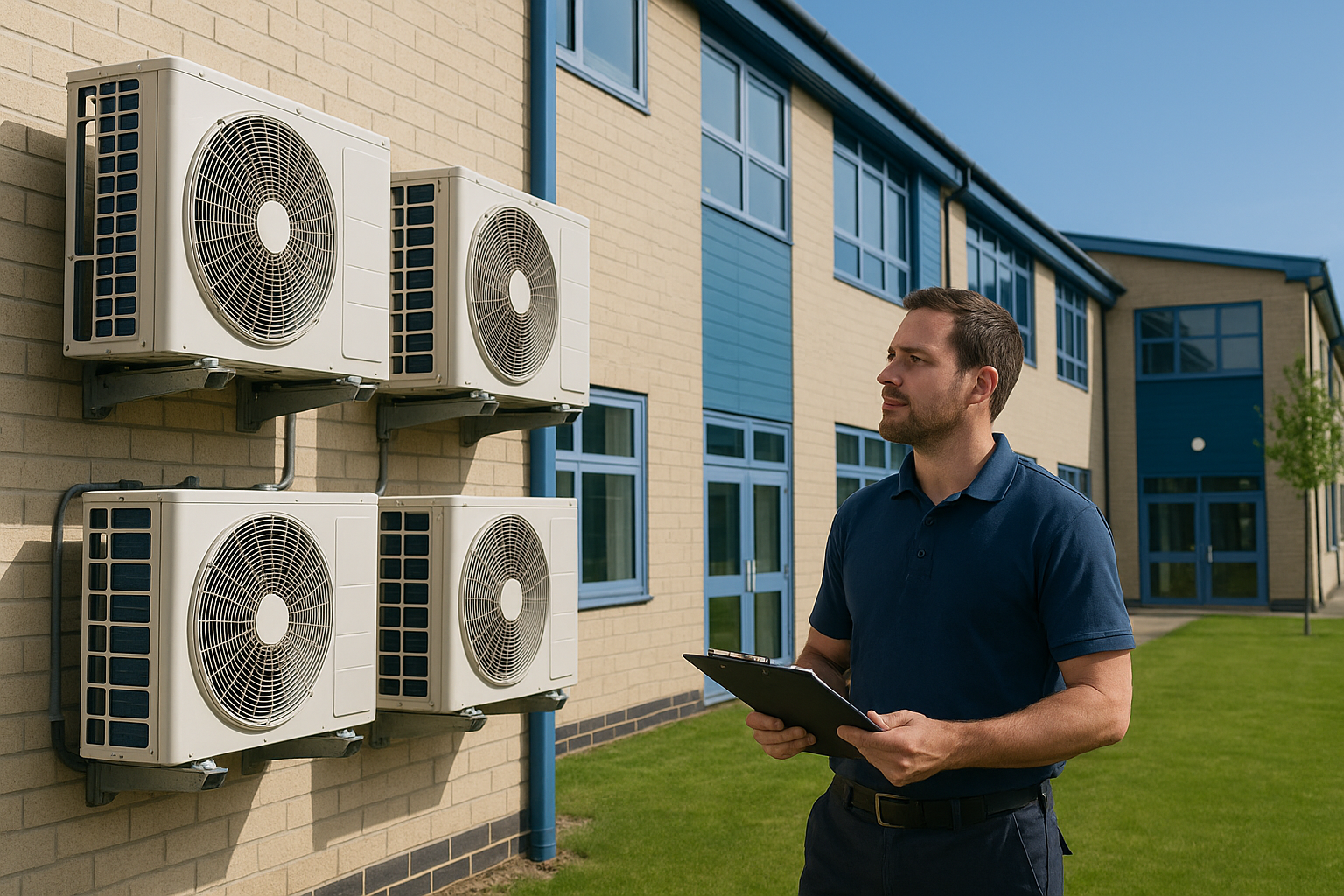
What Is a TM44 Inspection and Why Do Schools Need One?
A TM44 inspection is a mandatory energy assessment of air conditioning systems in buildings across England and Wales. The requirement originates from the Energy Performance of Buildings Regulations 2012 and applies to any system — or combination of systems — with a total effective rated output exceeding 12kW. The inspection must be carried out by an accredited energy assessor and repeated at least every five years.
Schools are particularly likely to fall within scope because modern and refurbished educational buildings frequently use split systems, VRF units, or centralised cooling across multiple classrooms, server rooms, ICT suites and administrative offices. Even if individual units are modest in size, once the combined output across the site exceeds 12kW, TM44 inspections for schools become a legal obligation. For a full breakdown of what the assessment involves, visit our page explaining what a TM44 inspection is.
The Legal Basis in Plain Terms
Under Regulation 18 of the Energy Performance of Buildings (England and Wales) Regulations 2012, the person responsible for the operation of the air conditioning system — typically the headteacher, the academy trust, or the local authority — must ensure a valid inspection report is in place. For maintained schools, the local authority may ultimately bear responsibility. However, academy trusts and free schools have no such backstop — the duty rests squarely with the trust as building operator. The Education and Skills Funding Agency (ESFA) financial management and governance framework expects trusts to demonstrate full regulatory compliance, meaning a missing TM44 certificate can surface in external audits and governance reviews, not just enforcement actions.
The UK government guidance on air conditioning inspections for buildings confirms these requirements and provides further detail on enforcement and penalties.
Why TM44 Inspections for Schools Are Often Overlooked
In our experience carrying out TM44 inspections for schools across the North East and Yorkshire, we consistently find that educational settings miss their obligations for the same recurring reasons:
- Fragmented responsibilities: Facilities management is often split between the school, a multi-academy trust central team, the local authority and external FM contractors. Nobody is entirely certain who owns the compliance task — so it falls through the gap.
- Piecemeal system installation: Air conditioning units are added over time — a split system in the server room, comfort cooling in the head’s office, units in a new teaching block — until the combined output quietly exceeds 12kW without anyone recalculating the total.
- Confusion with F-Gas or maintenance visits: Regular servicing and F-Gas leak checks are not the same as a TM44 energy inspection. Many bursars assume their maintenance contractor covers this requirement, but unless the engineer holds a Level 3 or Level 4 energy assessor accreditation, the service visit does not satisfy the TM44 legal duty.
- Budget pressures: School budgets are perpetually stretched, and compliance inspections can be deferred when they are not fully understood. However, the cost of non-compliance — both in fines and wasted energy — typically far exceeds the fee for TM44 inspections for schools.
How to Determine Whether Your School Requires a TM44 Inspection
The first step is establishing whether your total installed cooling capacity exceeds 12kW. Here is a practical approach for bursars and site managers.
Step 1: Audit Every Cooling System on Site
Walk the entire site and identify every piece of air conditioning or comfort cooling equipment. Include split units, cassette units, ducted systems, VRF/VRV systems, portable units connected to external condensers, and any cooling provided through an air handling unit. Do not overlook server rooms, music practice rooms, libraries or temporary buildings — these are the spaces most commonly missed during an initial audit.
Step 2: Record the Rated Cooling Output
Check the nameplate on each outdoor unit or refer to the manufacturer’s technical data sheet. You are looking for the cooling capacity in kW. Sum the figures for every system on the site. If the total exceeds 12kW, TM44 inspections for schools are legally required for your premises.
Step 3: Check for an Existing Valid Certificate
If your school has had a TM44 inspection before, check its date. Certificates are valid for five years. If your certificate has expired, or you cannot locate one at all, you need to arrange a new inspection without delay — there is no grace period once a certificate lapses.
Step 4: Book an Accredited Assessor
Ensure you instruct an assessor with the correct level of accreditation for your system type. At AirCert, we hold both Elmhurst Level 3 and Level 4 accreditation, meaning we are qualified to inspect systems of any size and complexity — from a single classroom split unit to a full VRF installation serving an entire campus. Request a quote here for a prompt, no-obligation price.
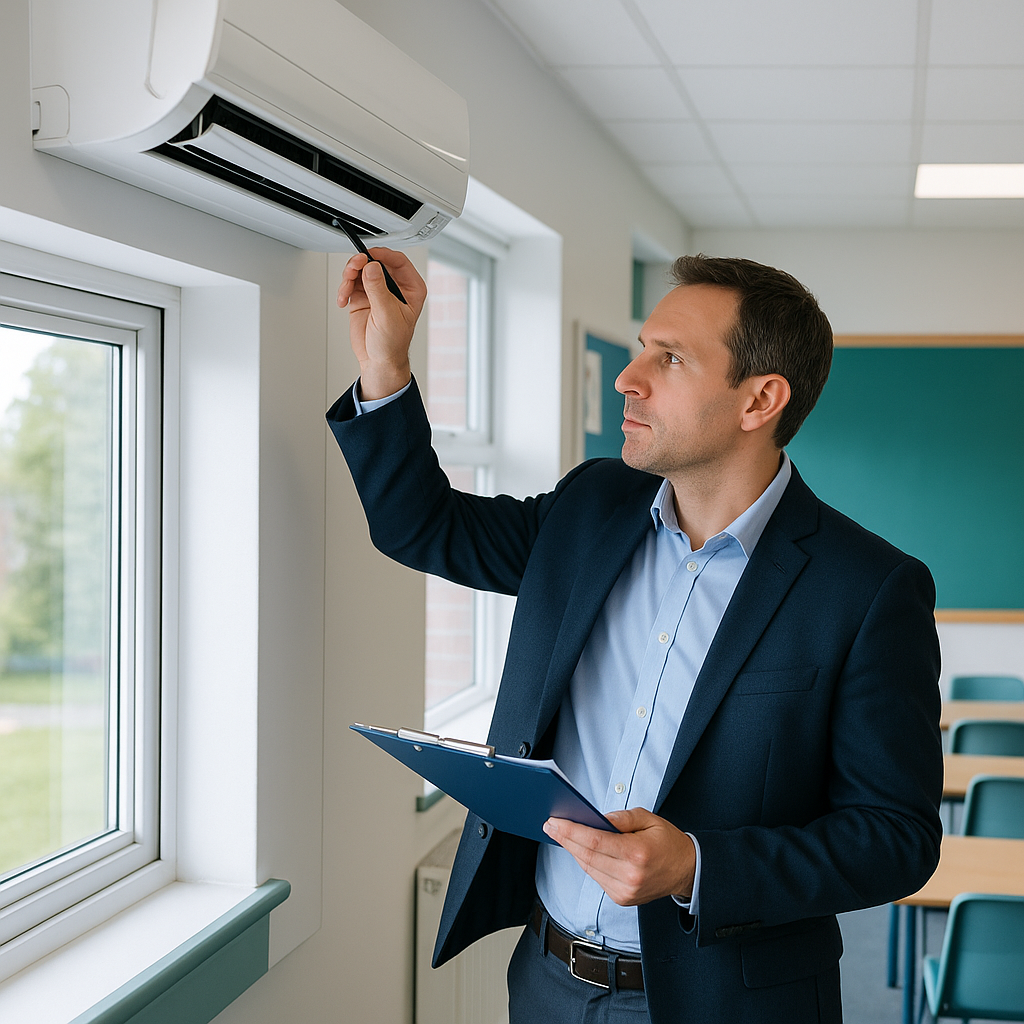
What Happens During TM44 Inspections for Schools?
TM44 inspections for schools follow the same structured methodology used for any commercial premises, but our assessors are experienced in working around the unique demands of an educational environment — minimising disruption to teaching, coordinating access around timetables, and liaising sensitively with site staff.
The inspection covers the following areas:
- System identification and sizing: We verify the type, age, refrigerant and rated output of every air conditioning unit on site.
- Assessment of system condition: We examine whether equipment is well maintained, correctly charged and free from obvious defects that impair efficiency.
- Controls evaluation: We check whether thermostats, timers and building management system (BMS) controls are set appropriately and functioning correctly. In schools, we frequently find systems running during holidays or competing with open windows — both significant and easily corrected sources of energy waste.
- Zoning and load matching: We assess whether the cooling provided is proportionate to the space it serves. Oversized systems — common in schools where rooms have changed use since installation — waste energy and money.
- Recommendations report: The final TM44 certificate includes prioritised recommendations for improving energy efficiency. These are advisory, not mandatory, but they often identify quick wins that pay for the cost of TM44 inspections for schools many times over.
Common Findings from TM44 Inspections for Schools in the North East
Having carried out TM44 inspections for schools across Middlesbrough, Teesside, County Durham, Tyne and Wear, and Yorkshire, we consistently encounter the same issues in educational buildings:
- Systems running outside occupied hours: Timer settings are incorrect or have been overridden, meaning units cool empty classrooms overnight, at weekends and throughout school holidays.
- Simultaneous heating and cooling: Radiators and air conditioning running at the same time in the same room is astonishingly common in older school buildings with retrofitted cooling — and one of the costliest inefficiencies we find.
- Dirty filters and blocked condensers: Reduced airflow forces compressors to work harder, increasing electricity consumption by 10–20% compared to a well-maintained system.
- Legacy refrigerants: Older systems using R22 or other phased-out refrigerants cannot be recharged legally and should be prioritised for replacement — both for compliance and long-term cost reasons.
- Missing or poorly calibrated controls: Wall-mounted thermostats set to their lowest possible temperature, or remote controls lost behind furniture, are surprisingly frequent discoveries during TM44 inspections for schools.
Addressing these findings can deliver meaningful energy savings for schools operating under tight budget constraints. A well-executed TM44 inspection is not just a compliance exercise — it is a genuine opportunity to reduce running costs and redirect money towards pupils.
Penalties for Non-Compliance
Enforcement of TM44 inspections for schools is carried out by Trading Standards Officers (TSOs), who check compliance via the government’s Landmark database — the national register where all valid TM44 certificates are lodged. This means officers can identify non-compliant buildings without a site visit. The full penalty structure is more severe than most bursars realise:
- Initial fine — £300 for failing to hold a valid TM44 inspection report
- Weekly repeat fines — £300 per week until the building achieves compliance — this is not a one-off charge
- Failure to produce documentation — £200 if the certificate cannot be produced within seven days of a TSO request
- Cumulative exposure — £5,000+ when weekly fines, documentation penalties and multiple non-compliant systems across a trust estate are combined
Beyond the financial penalties, non-compliance represents a reputational and governance risk — particularly for academy trusts that must demonstrate sound regulatory management to the ESFA, governors and Ofsted. It also means your school is almost certainly wasting energy that could be redirected to the classroom.
TM44 Inspections for Schools: Practical Tips for Bursars and Site Managers
Plan Inspections During Holidays
The most convenient time to carry out TM44 inspections for schools is during half-term breaks or the summer holiday, when every room is accessible without disrupting lessons. We recommend booking well in advance to secure your preferred dates — summer slots fill quickly in the North East and Yorkshire.
Gather Documentation Beforehand
Having maintenance records, installation dates and system manuals available speeds up the inspection and improves the quality of recommendations provided. If you do not have these records, the inspection can still proceed — our assessors are experienced at working efficiently with limited information.
Combine with Your Compliance Calendar
Add TM44 renewal dates to your existing compliance tracking system alongside fire risk assessments, DEC certificates, asbestos reviews and legionella checks. A five-year cycle is easy to manage once it is in your diary. Many clients also coordinate TM44 inspections for schools with their F-Gas service checks, completing both requirements in a single site visit to minimise disruption.
Act on the Recommendations
The advisory recommendations in a TM44 report are not legally binding, but implementing low-cost and no-cost measures — adjusting timer settings, replacing filters, calibrating thermostats — can reduce your electricity bill significantly. Present the report to your trust board or governing body as evidence of proactive energy and compliance management.
Why Choose AirCert for TM44 Inspections for Schools?
AirCert is based in Middlesbrough and covers the entire North East of England and Yorkshire. We hold Elmhurst Level 3 and Level 4 accreditation, meaning we are fully qualified to carry out TM44 inspections for schools of every size and configuration — from a small primary with a handful of wall-mounted units to a large secondary campus with centralised VRF plant.
We understand the operational realities of school environments. We work discreetly around pupils and staff, coordinate with your site team, and provide clear, jargon-free reports that bursars and headteachers can present with confidence to governors or trust boards. Our pricing is transparent and competitive, and we are happy to provide fixed quotes for multi-site academy trusts.
Get a quote from AirCert today and ensure your school meets its TM44 legal obligations without fuss or unnecessary expense.
Summary
TM44 inspections for schools are a legal requirement that protects your budget, improves energy efficiency, and demonstrates responsible governance. If your school’s air conditioning systems have a combined output exceeding 12kW, you must hold a valid TM44 certificate renewed every five years — or face weekly repeat fines that can accumulate beyond £5,000. With proper planning and an accredited assessor, compliance is straightforward and the inspection itself delivers genuine value through actionable energy-saving recommendations. Do not wait for an enforcement notice — arrange your TM44 inspection today and keep your school fully compliant.